Defang Blog
The AI-Native Software Factory
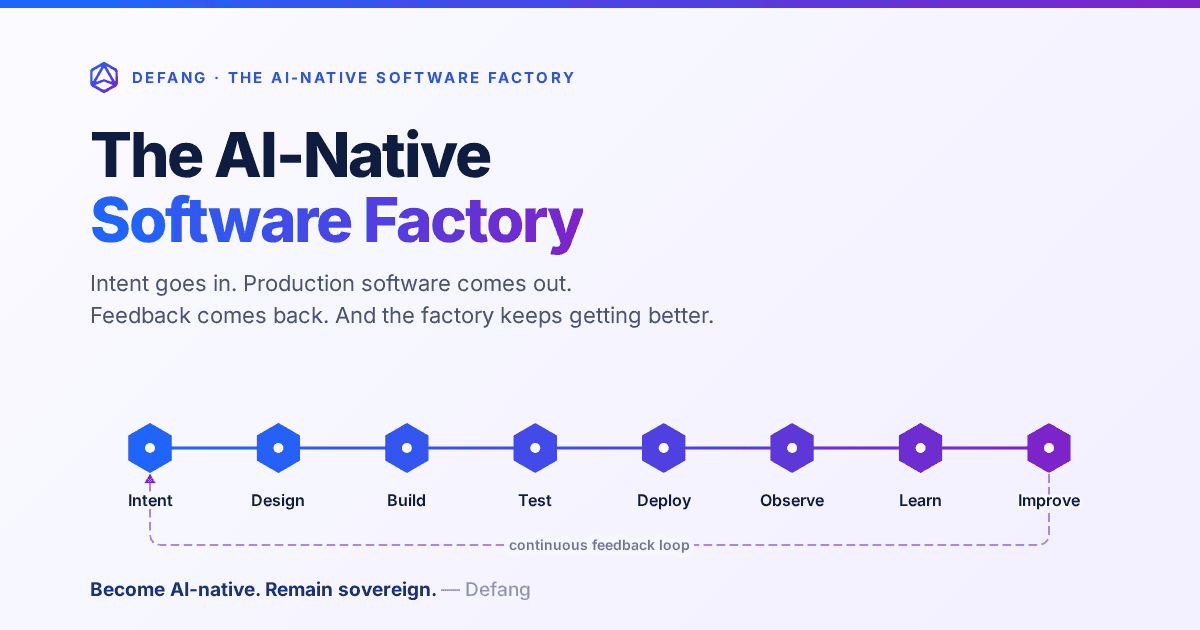
For decades, a true software factory was mostly aspirational. AI changes that: an end-to-end system that continuously turns intent into production software—and production feedback into the next improvement.
For decades, software development has borrowed the language of manufacturing: pipelines, builds, releases, production.
But until recently, the idea of a true software factory was mostly aspirational.
We automated pieces of software delivery—builds, tests, infrastructure, deployments and monitoring—but the process as a whole remained human-driven. People still had to interpret customer needs, design solutions, write code, diagnose problems and decide what to change next.
AI changes that.
What Is a Software Factory?
A software factory is a standardized, repeatable system for producing high-quality software.
Traditionally, that meant automating the path from code to production: CI/CD, testing, security, deployment and operations.
AI enables a broader definition:
A software factory is an end-to-end system that continuously transforms intent into production software—and production feedback into the next improvement.
The input might be a product requirement, an engineering task, customer feedback or observed user behavior.
The output is not just code. It is a solution that has been designed, implemented, tested, deployed and monitored.
Then the process begins again:
Intent → Design → Build → Test → Deploy → Observe → Learn → Improve
That closed loop is what distinguishes a true software factory from a collection of automation tools.
Why the Factory Must Be AI-Native
Traditional automation works well when the steps are deterministic.
Given this code, run these tests. Given this container, deploy it. If this service fails, restart it.
But the hardest parts of software development require reasoning.
What does the customer actually want? How should a feature fit into the architecture? Why did a test fail? What should change based on what we are seeing in production?
Historically, humans connected those steps.
AI agents increasingly can. They can interpret unstructured input, understand application context, plan work, modify code, run tests, inspect results and iterate toward an objective.
That means we can automate not just individual stages of software delivery, but increasingly the workflow between them.
A software factory is therefore not simply a CI/CD pipeline with an AI coding tool attached.
It has to be AI-native by design.
Humans Still Matter
AI-native does not mean human-free.
Humans define objectives, architecture, constraints and quality standards. They decide what can be delegated and where approval is required.
Agents perform more of the execution between those boundaries.
The key shift is:
Humans move from manually carrying work through the process to designing and governing the system that carries the work.
That is what makes new experiences possible: software that can respond to customer feedback, production signals or changing requirements; propose or implement improvements; validate them; and evolve within defined guardrails.
The competitive advantage is no longer just the software an organization has already built.
It is the organization's ability to continuously produce, operate and improve software.
Cloud computing made infrastructure programmable.
AI is now making increasingly large parts of software engineering programmable as well.
That is the AI-native software factory:
Intent goes in. Production software comes out. Feedback comes back. And the factory keeps getting better.
In Part 2, we'll look at what it takes to build one.
Related posts
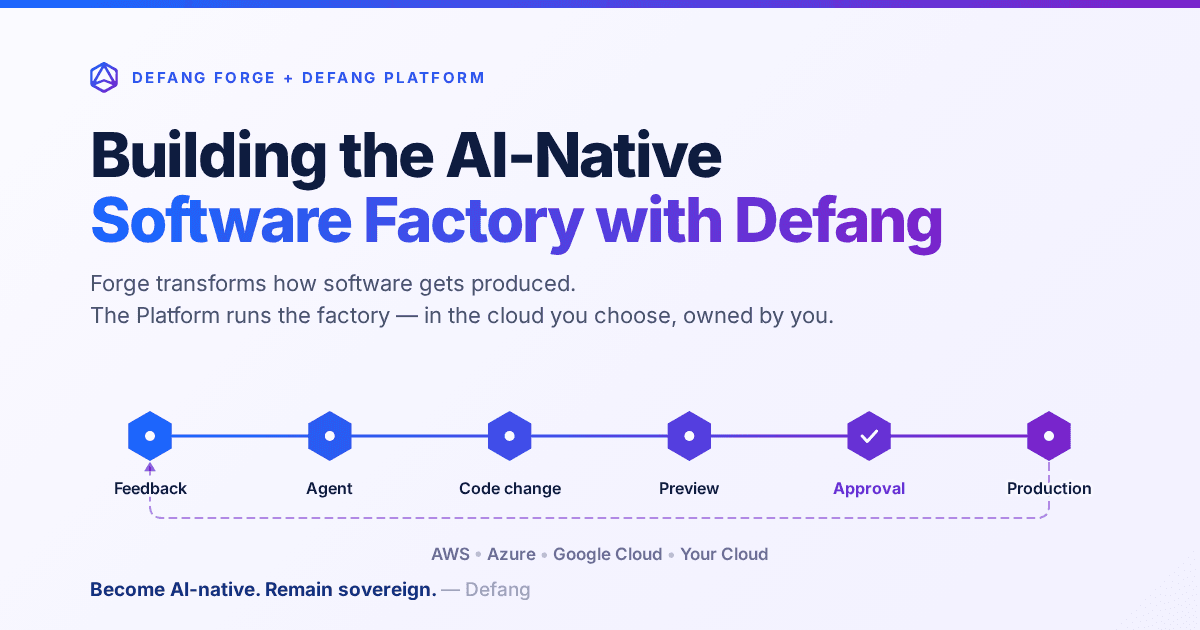
Building the AI-Native Software Factory with Defang
Building an AI-native software factory takes more than a coding agent. It takes people, agents, tools, infrastructure and governance working as one system—and it should belong to you. Here's how Defang Forge and the Defang Platform fit together.
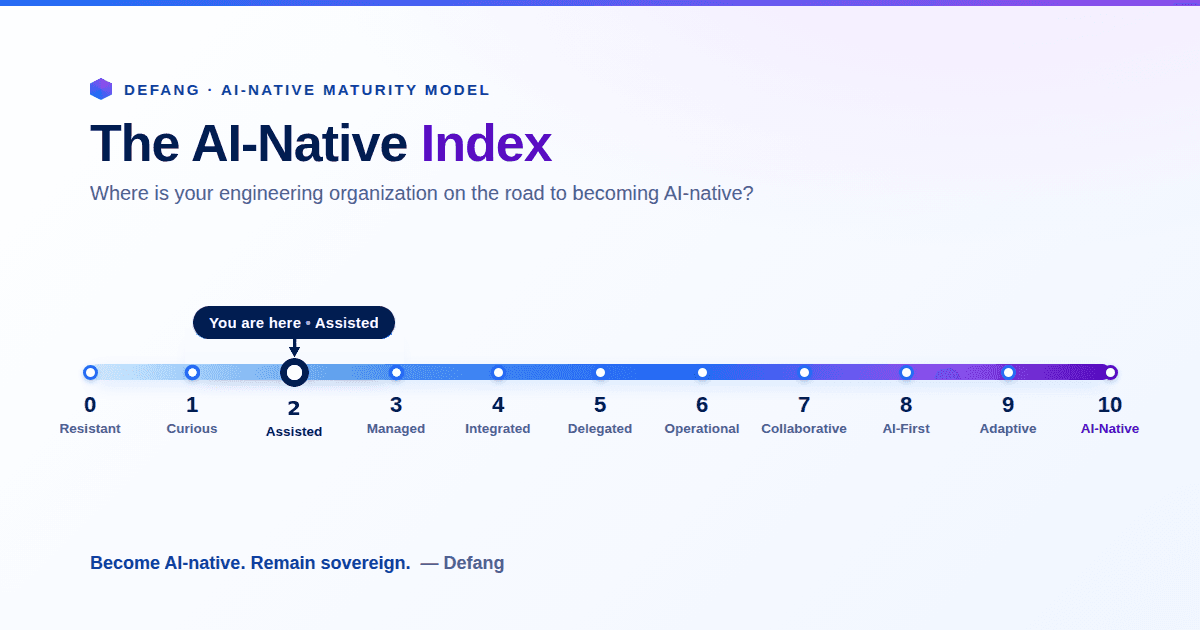
The AI-Native Enterprise: Redesigning Engineering for the AI Era
The next wave of competitive advantage won't come from adopting another AI tool. It will come from redesigning engineering around humans and AI agents working together, while preserving engineering sovereignty.
Introducing Defang Forge: Helping Companies Build for the AI-Native Era
Today, we are excited to introduce Defang Forge, a new engineering practice from Defang that helps organizations design, build, and deploy AI-native software.